Unpacking How Dynamic Resolution Scaling in Cloud-Rendered Titles Affects Visual Consistency Across Variable Network Conditions in Global Player Bases

Cloud-rendered titles rely on dynamic resolution scaling to maintain playable frame rates when bandwidth fluctuates, yet this adjustment directly influences how consistently players perceive image clarity across different regions and connection qualities. Servers detect packet loss or latency spikes and reduce render resolution in real time, which compresses detail and alters sharpness without player intervention. Observers note that these shifts become most visible during fast-motion sequences where lower pixel counts produce softer edges and reduced texture fidelity.
Mechanics of Dynamic Resolution Scaling in Cloud Environments
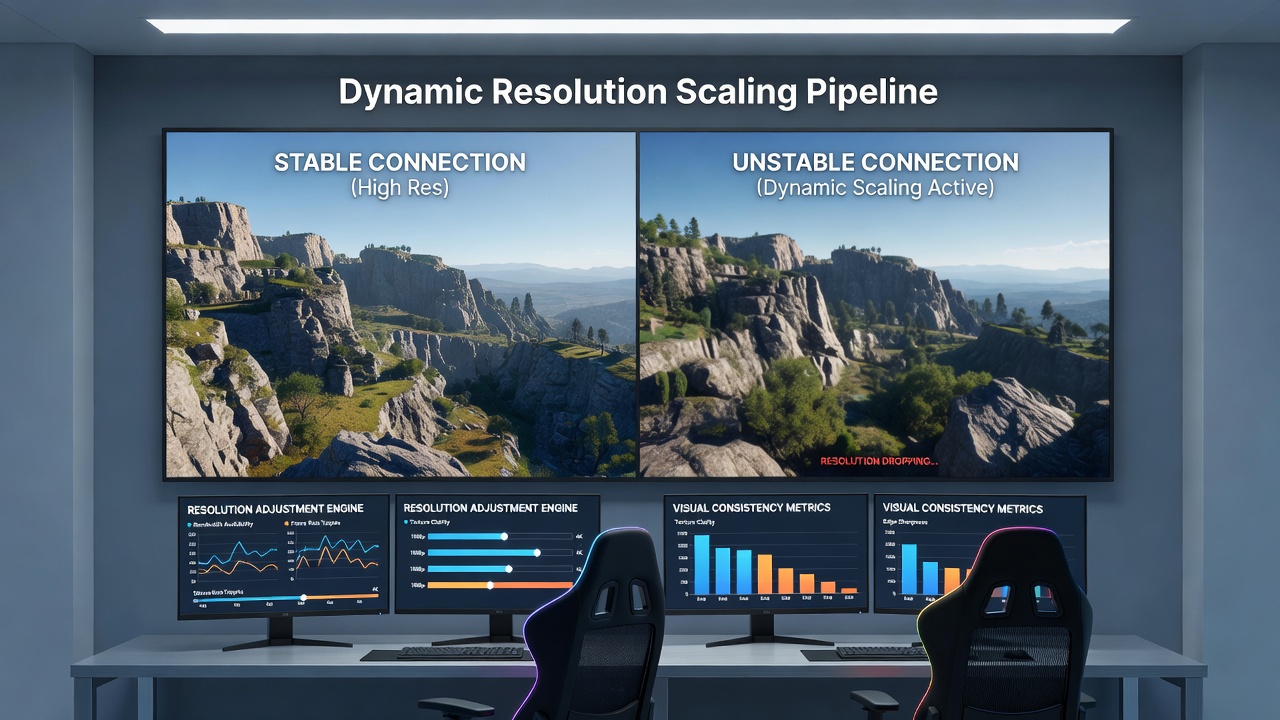
Cloud platforms implement dynamic resolution scaling through encoder-side algorithms that monitor upstream network telemetry every few milliseconds. When throughput drops below thresholds such as 15 Mbps for 1080p streams, the system lowers internal rendering resolution from native 1440p to 720p or even 540p before encoding. This process preserves frame delivery but changes the amount of visual information transmitted, and studies from network research groups show that abrupt drops create noticeable banding in gradients and loss of fine particle effects. Game engines running on remote GPUs receive the new resolution target and adjust their render targets accordingly, which means the same scene can appear crisp one moment and softened the next depending solely on instantaneous network state.
Network Variability and Its Direct Influence on Visual Output
Variable network conditions arise from congestion at peering points, last-mile throttling, or regional infrastructure limitations, each producing distinct patterns of resolution fluctuation. In areas with stable fiber connections, resolution remains locked near target levels for extended periods, delivering steady detail retention. Conversely, mobile 5G users in dense urban zones experience frequent micro-adjustments that manifest as cycling between sharp and blurred states within single gameplay sessions. Data collected during 2025 infrastructure audits indicate that average resolution variance reaches 35 percent in markets with mixed copper and wireless backhaul, compared with under 10 percent in dedicated fiber corridors. These swings affect not only static image quality but also motion clarity, because lower-resolution frames require less aggressive motion-vector compression yet still lose sub-pixel accuracy during rapid camera pans.
Regional Differences Across Global Player Bases
Player bases distributed across continents encounter markedly different consistency profiles because internet reliability varies by regulatory frameworks and investment levels. North American metropolitan centers report sustained higher average resolutions during peak evening hours, while certain Southeast Asian markets show more frequent downscaling events tied to shared international gateways. European regulators have documented similar patterns through broadband performance reports, noting that cross-border traffic routing adds latency variability that compounds resolution instability. Australian studies of cloud service performance further reveal that long-haul routing to centralized data centers amplifies these effects, producing longer periods of reduced resolution for players in remote territories compared with those near coastal server clusters.
One documented case involved a major cloud platform that adjusted its scaling thresholds in June 2026 after telemetry revealed persistent resolution oscillation for users on satellite backhaul links in South America. The update introduced smoother interpolation between resolution tiers, which reduced visible popping artifacts although overall pixel counts remained network-dependent.
Measured Effects on Visual Consistency Metrics
Researchers tracking visual consistency typically record metrics such as temporal resolution variance, edge preservation scores, and perceptual sharpness indices across thousands of concurrent streams. Findings from academic labs in Japan and Canada demonstrate that sessions experiencing more than four resolution changes per minute register significantly lower consistency scores, even when average bitrate stays constant. These measurements matter because players in competitive modes rely on consistent edge definition for target acquisition, and repeated softening can obscure small environmental cues. Industry reports compiled by the Entertainment Software Association highlight that titles employing aggressive upscaling filters after downscaling show partial recovery of perceived detail, yet the underlying pixel data remains limited by the lowest resolution tier reached during the session.
Technical Mitigations and Their Limitations
Developers have explored several approaches to mitigate inconsistency, including predictive bandwidth estimation that preemptively lowers resolution before congestion fully materializes, and client-side sharpening passes that attempt to restore edge contrast. While these techniques narrow the gap between high- and low-resolution states, they cannot manufacture information absent from the encoded stream. Tests conducted on European testbeds indicate that even advanced temporal upscalers leave measurable gaps in texture detail compared with native-resolution renders delivered under stable conditions. Global standardization efforts continue through bodies such as the ITU, which track how different encoding profiles interact with regional network characteristics.
Conclusion
Dynamic resolution scaling remains a core adaptation mechanism for cloud-rendered titles, yet its operation ties visual output directly to instantaneous network performance across worldwide player populations. Regional infrastructure differences produce divergent consistency patterns that platforms address through threshold tuning and post-processing, while measurement frameworks continue to quantify the resulting shifts in image fidelity. As cloud deployments expand into additional markets through 2026, the interplay between network conditions and rendered resolution will determine how uniformly players experience visual detail regardless of location.