Satellite Broadband Expands Access for Remote Competitors in Global Esports Events

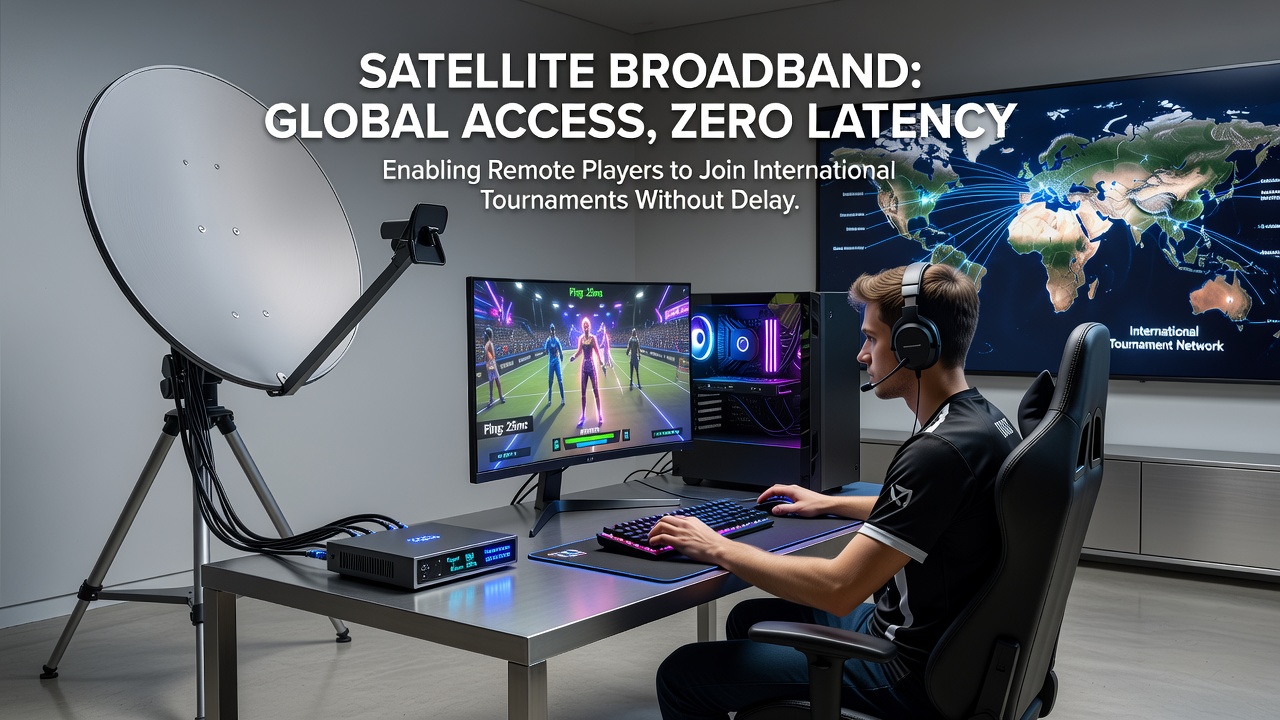
Low-earth orbit satellite networks have connected isolated regions to high-speed internet services that support real-time competitive gaming, allowing participants from areas lacking fiber or cable infrastructure to enter international tournaments on equal footing with urban players. These systems bypass the need for extensive ground-based cabling by beaming signals directly from space-based arrays, which reduces deployment timelines from years to months in challenging terrains such as mountainous zones or island communities.
Operators have rolled out thousands of satellites since the early 2020s, creating coverage footprints that span continents and oceans. Data from regulatory filings shows download speeds reaching 100 megabits per second or higher in many test locations, with upload rates sufficient for streaming gameplay footage alongside live tournament feeds. Latency figures hover between 20 and 40 milliseconds under optimal conditions, which meets the thresholds required by most multiplayer titles for precise input registration.
Technical Foundations of Satellite Connectivity for Esports
Constellations positioned at altitudes between 500 and 1200 kilometers deliver lower propagation delays than traditional geostationary satellites that orbit much farther out. Ground terminals equipped with phased-array antennas track these moving satellites automatically, maintaining stable links even when players relocate their setups within a property. Multiple providers coordinate spectrum usage through international agreements that allocate specific frequency bands to avoid interference during peak tournament hours.
Research conducted by institutions in Canada and Australia demonstrates that these networks maintain packet loss rates below 1 percent during extended sessions, a metric that directly influences hit registration and movement synchronization in fast-paced genres. Adaptive coding and modulation techniques adjust signal parameters in response to weather events, preserving connection quality when rain or snow affects signal paths.
Deployment Patterns Across Remote Regions
Government programs in North America and Europe have subsidized terminal installations for educational and community centers that double as practice hubs for aspiring competitors. In parts of Southeast Asia and South America, private operators partnered with local esports organizations to equip training facilities in rural provinces, enabling qualifiers for events scheduled throughout 2026. One documented case involved a player in northern Canada who joined a European-based league after a terminal installation completed in under three weeks.
Statistics compiled by the International Telecommunication Union indicate that satellite subscriptions in underserved areas grew by more than 40 percent between 2024 and 2025, with gaming-related traffic comprising an increasing share of total data consumption. This expansion coincides with hardware improvements that lower power requirements, making the systems viable for locations dependent on solar or generator supplies.
Integration with Tournament Infrastructure
Event organizers now incorporate satellite options into their participation guidelines, requiring only a stable terminal and compatible router rather than proximity to metropolitan data centers. Software tools monitor jitter and round-trip times in real time, flagging any deviations that might affect fairness before matches begin. Several major circuits held preliminary rounds in June 2026 that explicitly welcomed satellite-connected entrants, resulting in broader geographic representation among finalists.
Network slicing features allow tournament traffic to receive priority handling over general consumer usage, minimizing congestion when multiple household devices operate simultaneously. Providers publish service-level agreements that specify uptime guarantees exceeding 99 percent, figures that align with the reliability standards demanded by professional leagues.
Observed Performance Metrics and Adjustments
Field measurements collected during live events reveal that satellite links perform comparably to terrestrial broadband once initial handshakes complete, although occasional satellite handovers introduce brief spikes that teams mitigate through predictive buffering algorithms. Studies from European research centers note that players adapt quickly to these characteristics after a short calibration period, often achieving win rates equivalent to those recorded on fiber connections.
Equipment manufacturers have introduced compact terminals designed for rapid transport between practice sites and competition venues, complete with integrated cooling systems that sustain performance during extended heat exposure. These units support both fixed and mobile configurations, opening possibilities for competitors who travel frequently between remote training camps and event locations.
Conclusion
Satellite broadband continues to reshape participation patterns in international gaming circuits by removing geographic barriers that once restricted entry to well-connected urban centers. Ongoing constellation expansions and terminal refinements extend these capabilities further, supporting larger numbers of remote competitors in events scheduled through the remainder of 2026 and beyond. Regulatory bodies across multiple continents track these developments to ensure spectrum resources remain available for growing demand.