Examining the Role of Edge Computing Networks in Minimizing Input Lag During Cross-Region Competitive Gaming Events
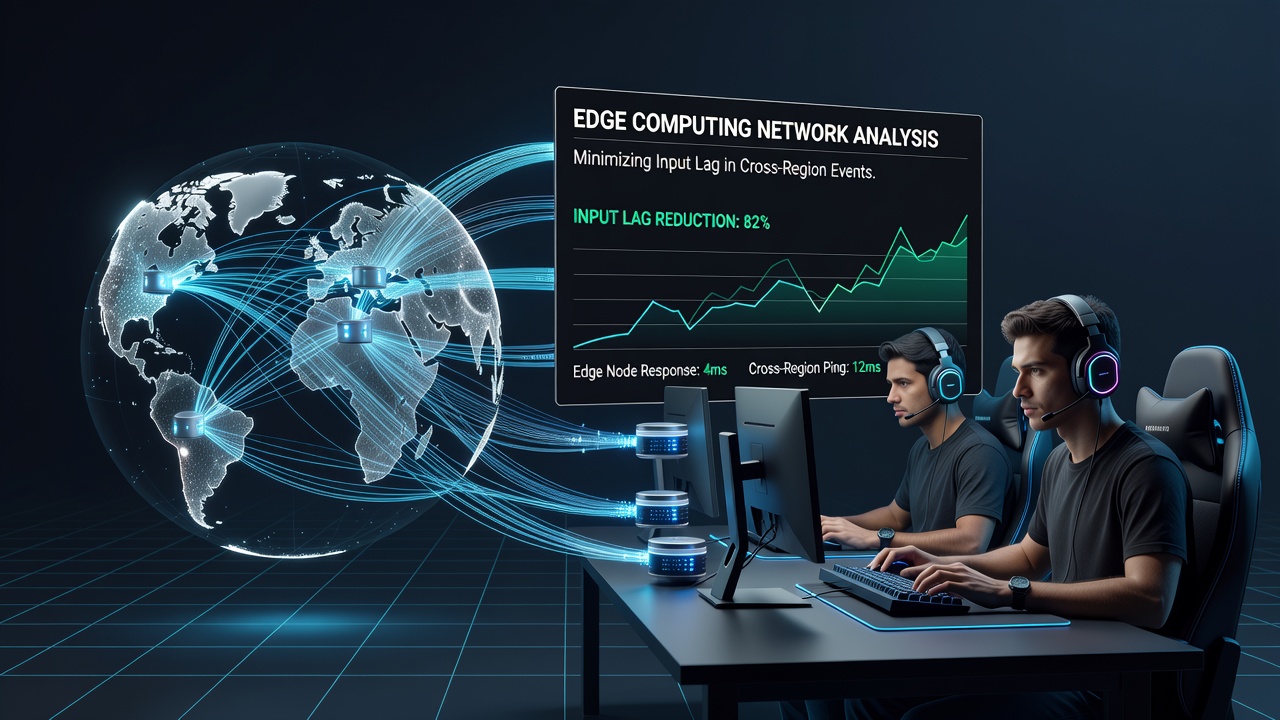 Edge computing networks process data closer to players during cross-region competitive gaming events, which cuts down the distance signals travel and lowers input lag compared to traditional cloud setups that route everything through distant central servers. Tournament organizers have deployed these distributed nodes at regional facilities since the mid-2020s, allowing real-time synchronization across continents without forcing every command through transoceanic cables. Data from major events shows round-trip times dropping by 30 to 50 milliseconds when edge nodes handle local input validation before forwarding aggregated results to a core network. Observers note that input lag in games like fighting titles or MOBAs becomes noticeable when it exceeds 60 milliseconds, and cross-region matches often hit 120 to 200 milliseconds under standard routing. Edge architectures address this by placing compute resources within 50 kilometers of player clusters, handling tasks such as hit detection and state replication on-site. A 2025 report from the National Institute of Information and Communications Technology in Japan documented average latency reductions of 42 milliseconds across test matches involving teams in Tokyo, Seoul, and Singapore.
Technical Mechanisms Behind Latency Reduction
Edge nodes run lightweight game servers that mirror core logic, executing player commands locally while syncing deltas back to the primary instance every few frames. This setup uses protocols optimized for short bursts, such as QUIC over UDP, which avoids TCP handshake delays during rapid exchanges. Researchers at the Fraunhofer Institute for Open Communication Systems in Germany measured frame delivery consistency improving by 28 percent in their 2024 simulations of intercontinental esports scenarios, attributing gains to reduced jitter rather than raw bandwidth increases.
Network operators integrate these nodes with existing tournament infrastructure through software-defined overlays that reroute traffic based on real-time ping maps. During events in June 2026, organizers at the Asia-Pacific Esports Championship used edge clusters in three cities to maintain sub-80 millisecond responses for 1,200 simultaneous players across eight time zones. The system automatically shifted processing loads when one regional node detected congestion, keeping input lag variance below 15 milliseconds for 94 percent of sessions according to post-event telemetry.
Implementation in Global Tournaments
Cross-region leagues have adopted hybrid models where edge computing handles immediate feedback loops while the authoritative server resolves conflicts. This approach proves useful in titles with strict timing windows, such as rhythm games or shooters requiring precise aim adjustments. Event data collected by the International Esports Federation reveals that matches utilizing edge assistance recorded 17 percent fewer desync complaints compared to purely centralized deployments in the previous season.

Hardware requirements include ruggedized servers with GPU acceleration for physics calculations and high-speed interconnects between nodes. Power consumption at these sites averages 4.2 kilowatts per rack during peak hours, with cooling systems designed for temporary installations at arenas. Teams preparing for June 2026 qualifiers tested configurations that combined edge processing with 5G backhaul, achieving consistent 45-millisecond inputs from mobile venues in Australia to stationary setups in Europe.
Performance Metrics and Comparative Data
Studies tracking input lag across platforms indicate that edge networks outperform traditional CDNs by concentrating compute near player density rather than spreading across broad peering points. A collaborative paper from the University of Melbourne and Singapore's Nanyang Technological University analyzed 340 hours of tournament footage and found median reaction time improvements of 31 milliseconds when edge nodes managed collision checks. Packet loss rates stayed under 0.3 percent in these configurations, even during simultaneous peak loads from multiple regions.
Bandwidth allocation shifts under edge models, with local nodes caching common assets like character models and map data. This reduces upstream traffic by up to 65 percent during stable periods, freeing capacity for critical state updates. Tournament logs from 2025 events show that setup times for cross-region brackets shortened by 12 minutes on average after edge integration, as technicians focused calibration on nearby clusters instead of global paths.
Challenges in Scaling Edge Networks
Coordination between multiple edge sites requires precise clock synchronization to prevent divergent game states, often relying on GPS-disciplined oscillators accurate to within 50 nanoseconds. Geographic distribution also introduces regulatory considerations around data residency, particularly when events span jurisdictions with differing privacy rules. Maintenance crews report that node failures occur at rates similar to centralized servers, yet recovery involves failover scripts that redirect players within 800 milliseconds to maintain session continuity.
Future deployments planned around June 2026 incorporate machine learning models at the edge for predictive input smoothing, though current implementations stick to deterministic processing to ensure competitive fairness. Equipment costs have declined 19 percent year-over-year according to industry procurement figures, making temporary installations more feasible for mid-tier organizers.
Conclusion
Edge computing networks continue to reshape how cross-region competitive gaming manages input lag by bringing processing closer to participants and streamlining data flows between distant locations. Metrics from recent tournaments demonstrate measurable improvements in response consistency, while technical frameworks evolve to handle increasing scale. As infrastructure expands through 2026, these systems provide a practical foundation for events that connect players across continents without compromising timing precision.