Cloud Rendering Pipelines in Subscription Gaming: Bandwidth and Fidelity Analysis
Written by Morgan Hayes · Aug 13, 2026
Cloud Rendering Pipelines in Subscription Gaming: Bandwidth and Fidelity Analysis
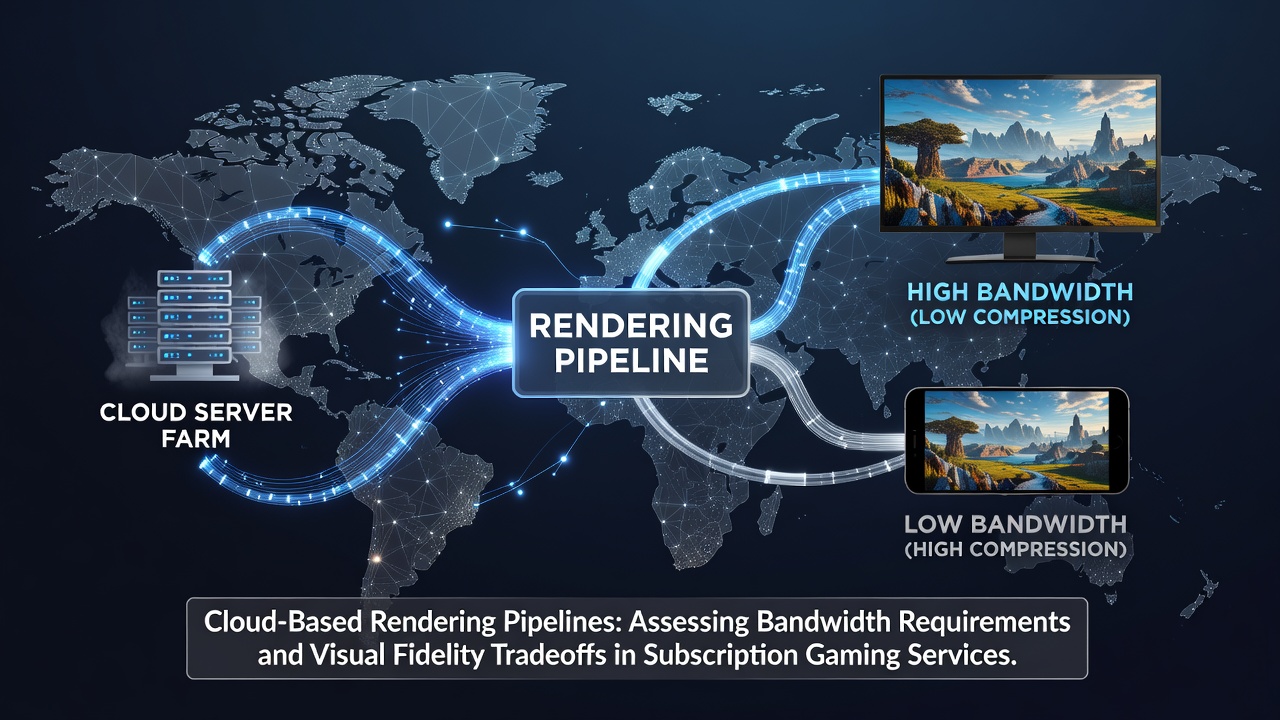
Cloud rendering pipelines handle game processing on remote servers before streaming video output to subscribers, and this setup shifts computational demands away from local hardware while introducing specific network dependencies. Subscription services such as those operating in 2026 rely on these systems to deliver titles without requiring high-end consoles or PCs at the user end, yet the approach creates measurable requirements for consistent data transfer rates. Researchers tracking service performance note that typical pipelines encode frames using codecs like H.265 or AV1, then transmit them over internet connections where latency and throughput directly influence output stability. Bandwidth needs vary based on resolution targets and frame rates, with 1080p streams often requiring sustained speeds between 15 and 25 megabits per second according to internal benchmarks shared by multiple providers. Higher resolutions push those figures upward, and 4K delivery can demand 35 to 50 megabits per second during peak action sequences when motion complexity increases data volume. Studies from network monitoring firms indicate that packet loss above 1 percent triggers noticeable artifacts, while jitter exceeding 30 milliseconds disrupts frame delivery timing and forces the pipeline to reduce quality settings dynamically. Visual fidelity tradeoffs emerge when services adjust encoding parameters to match available connections, and lower bitrates produce compression artifacts such as blockiness in detailed textures or blurring during rapid camera movements. Observers tracking August 2026 metrics across major platforms report that some operators now apply adaptive resolution scaling, dropping from native 4K to 1440p when bandwidth dips below thresholds for more than two seconds. This maintains playback continuity but alters perceived sharpness, and data from user telemetry shows retention rates remain stable provided the adjustments stay imperceptible during casual sessions.Pipeline Architecture and Data Flow
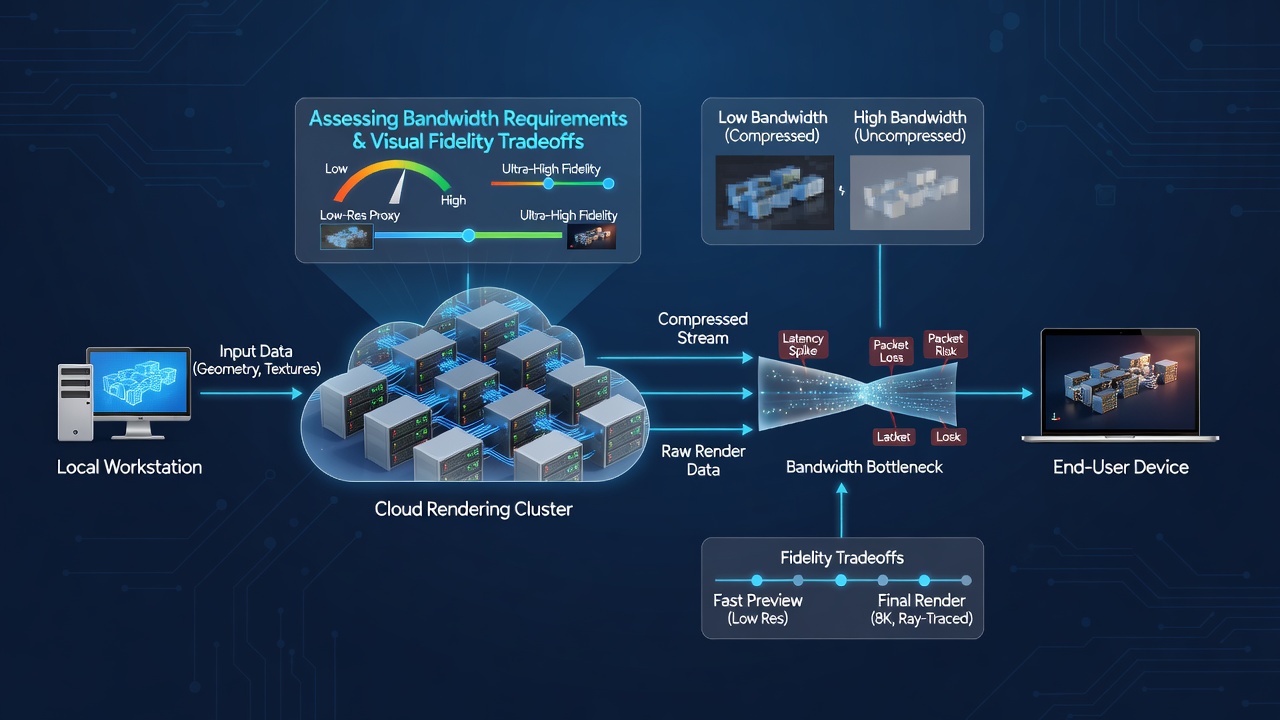
Modern cloud rendering begins with game logic execution on GPU clusters housed in regional data centers, after which rendered frames pass through capture buffers and enter encoding stages. The encoded stream travels via content delivery networks to end-user devices, where decoders reconstruct the image for display. Those who have examined these systems point out that each hop adds potential delay, and providers mitigate this by placing servers within 50 kilometers of major population centers to keep round-trip times under 40 milliseconds in optimal conditions.
Measured Bandwidth Demands Across Services
Figures compiled from service operators reveal consistent patterns, with GeForce Now sessions averaging 20 megabits per second for 1080p60 content while Xbox Cloud Gaming reports similar averages for equivalent settings. When subscribers enable higher visual presets, consumption rises proportionally, and peak usage during competitive matches can exceed baseline estimates by 30 percent. The Canadian Radio-television and Telecommunications Commission published connection quality data showing that 28 percent of households in rural areas lack the sustained upload and download symmetry needed for uninterrupted 4K cloud sessions, prompting some services to default those users to medium fidelity modes.
Fidelity Adjustments and User Impact
Encoding teams balance bitrate allocation between I-frames and P-frames to preserve motion clarity, yet aggressive compression reduces color depth and introduces macroblocking in high-contrast areas. Evidence from performance logs demonstrates that services employing AI-assisted upscaling recover some lost detail at the client side, allowing lower server-side bitrates without proportional quality loss. Those monitoring subscription metrics in August 2026 found that players on 50-megabit connections experienced fewer than three quality switches per hour on average, whereas connections below 25 megabits triggered switches every 12 minutes during demanding sequences.
Regional Infrastructure Variations
European operators face different constraints than their North American counterparts because fiber penetration rates differ across member states, and this affects how pipelines prioritize stream stability over peak fidelity. Industry reports from the Entertainment Software Association indicate that services targeting Asia-Pacific markets often implement region-specific codec profiles to accommodate variable mobile network conditions common in those territories. Such adaptations keep average session durations comparable across geographies even when raw bandwidth availability diverges.
Conclusion
Cloud rendering pipelines continue to evolve through codec improvements and edge server expansion, yet bandwidth requirements remain the primary limiter on achievable visual fidelity for subscription users. Data collected through 2026 shows clear correlations between connection quality and delivered resolution, while adaptive systems help services maintain playable experiences across diverse network environments. Providers that publish transparency reports on these metrics enable subscribers to make informed decisions about hardware and connectivity upgrades needed to access higher fidelity tiers.