Analyzing Data Compression Methods Applied to Real-Time Spectator Feeds During International Competitive Gaming Events
 International competitive gaming events rely on real-time spectator feeds that transmit gameplay footage to global audiences while maintaining synchronization across multiple viewing platforms. Organizers manage these streams through dedicated production pipelines that capture in-game visuals from tournament servers and distribute them via content delivery networks. Data compression plays a central role because raw video data volumes exceed available bandwidth in most venue and home connections. Engineers select codecs and encoding parameters based on measured latency budgets, typically targeting end-to-end delays below 500 milliseconds for live viewing experiences. Common methods include H.264/AVC for broad compatibility, HEVC/H.265 for improved efficiency at higher resolutions, and AV1 for royalty-free deployment in bandwidth-constrained regions. Each approach trades off computational complexity against bitrate savings. HEVC implementations often reduce required bandwidth by 40 to 50 percent compared with H.264 at equivalent perceived quality levels according to objective metrics such as PSNR and SSIM. AV1 encoders have demonstrated further gains in controlled tests yet require greater processing power on both encoding and decoding sides.
Latency and Quality Trade-offs in Tournament Settings
Production teams at major events balance compression aggressiveness against observable artifacts that affect viewer engagement. During July 2026 tournaments held across multiple continents, broadcast engineers monitored packet loss rates and adjusted quantization parameters dynamically through adaptive bitrate ladders. These ladders contained multiple simultaneous encodings at different resolutions and bitrates, allowing client devices to switch streams without interrupting playback.
Researchers documented frame-by-frame comparisons showing that HEVC maintained structural similarity scores above 0.95 at bitrates around 8 Mbps for 1080p60 content, whereas AV1 achieved similar scores near 6 Mbps under identical test conditions. Observers noted that hardware decoding support for AV1 remained limited on certain consumer devices during those events, prompting fallback to HEVC streams for older set-top boxes and mobile chipsets.Regional Infrastructure Influences on Codec Selection
Network conditions vary significantly between host countries and influence which compression schemes receive priority. Venues equipped with fiber backbones and low-jitter routing can sustain higher bitrates with lighter compression, whereas regions relying on shared satellite or mobile uplinks demand more aggressive reduction. Data collected from the 2026 circuit showed European events favoring HEVC due to widespread decoder support, while select Asian tournaments tested AV1 profiles on newer hardware to accommodate larger simultaneous viewer counts.
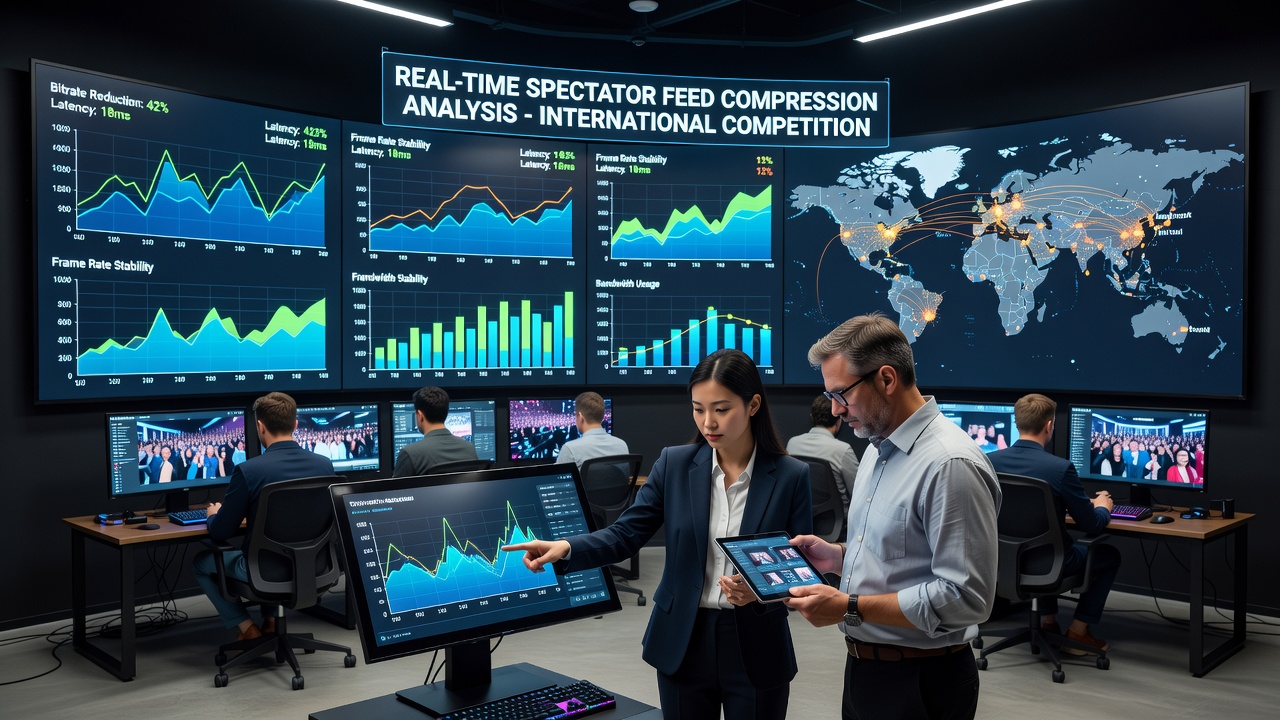 Industry reports from the European Broadcasting Union detail standardized measurement protocols used to evaluate these feeds. Separate studies coordinated through Canadian regulatory channels tracked how different compression settings affected accessibility for viewers on varied internet tiers. Both sources emphasize consistent logging of encoding delay, decoding delay, and cumulative jitter as key performance indicators.
Adaptive Streaming Architectures
Modern pipelines integrate real-time feedback loops that monitor client buffer levels and network throughput. When congestion occurs, systems switch to lower-bitrate renditions encoded with stronger quantization or reduced frame rates. Tournament operators in July 2026 implemented segment durations between two and four seconds to permit rapid adaptation without excessive buffering. Shorter segments increase overhead from repeated headers yet provide finer responsiveness during fluctuating conditions typical of large public venues.
Additional techniques such as temporal scalability layers allow decoders to drop frames gracefully rather than display artifacts when bandwidth drops suddenly. These layers function within HEVC and AV1 profiles, enabling smooth degradation from 60 fps to 30 fps while preserving spatial quality. Production logs indicate that such mechanisms reduced viewer complaints about stuttering during peak concurrent viewership periods.Measurement Frameworks and Comparative Data
Standardized testing suites measure both objective and subjective quality. Objective tools calculate bitrate versus distortion curves across representative gameplay sequences containing rapid motion and particle effects common in competitive titles. Subjective assessments involve controlled viewing sessions where participants rate perceived smoothness and clarity. Combined results guide parameter selection for future events and inform hardware procurement decisions for mobile decoding chips.
Conclusion
Compression method analysis for real-time spectator feeds centers on empirical measurements of latency, bitrate efficiency, and decoder availability across global audiences. Events in July 2026 demonstrated practical deployment of HEVC and AV1 alongside established H.264 streams, each tuned to local infrastructure and device ecosystems. Continued refinement of adaptive architectures and codec implementations supports expanding viewership while preserving the responsiveness required for competitive viewing.